# Variance
Variance measures the average value of the squared deviation from the mean. The instance with the *lowest* Variance is considered the *most* informative. Therefore, labeling this instance can be very useful to our model.
* If the Variance is **0**, then the model doesn’t have a clue about the correct label.
* If the Variance is **1**, then the model has a clear “belief” about the correct label.
Source
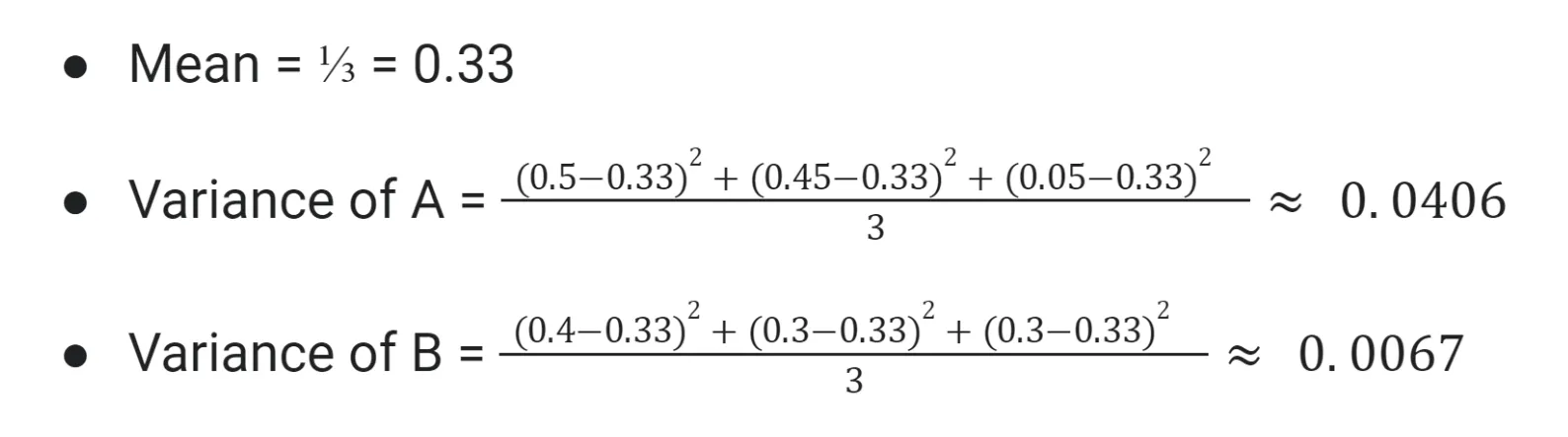
Imagine we have only 2 instances – A and B –, and the model has to decide which of them to suggest for annotation. It has made the following class predictions:
* Instance A: “cat” – 0.5, “milkshake” – 0.45, “cloud” – 0.05.
* Instance B: “cat” – 0.4, “milkshake” – 0.3, “cloud” – 0.3.
In this case, our model will choose instance B over A, as 0.0067 is less than 0.0406:
---
# Agent Instructions: Querying This Documentation
If you need additional information that is not directly available in this page, you can query the documentation dynamically by asking a question.
Perform an HTTP GET request on the current page URL with the `ask` query parameter:
```
GET https://docs.cloudfactory.com/active-learning/active-learning-in-hasty/variance.md?ask=
```
The question should be specific, self-contained, and written in natural language.
The response will contain a direct answer to the question and relevant excerpts and sources from the documentation.
Use this mechanism when the answer is not explicitly present in the current page, you need clarification or additional context, or you want to retrieve related documentation sections.